MLIS: Achievement Unlocked!

I graduated in May. Now that the dust has begun to settle, some people are asking what’s next. Have I started job hunting? What’s it like to have all that free time back? What grand and illustrious plans do I have for the future?

The truth is, there’s no rush. I have part time jobs at both San Francisco Public Library and Mechanics’ Institute Library, and though I’ve initiated career-advice conversations with librarians at both institutions, I’m mainly decompressing after three years of dedicated study. I’m doing a lot of pleasure reading, taking a weekend trip later in the summer, running a race this weekend, and generally just easing back into life after school. I’m readjusting to my post-constant-project-deadline reality by being still for a time, giving some thought to the kind of work I want to do at the starting line of my career.

DSCF5782

I enjoyed every class I took at SJSU’s iSchool, but I’m also glad to have completed the work, and to stand here on the threshold of putting all that education to good use. I feel the pressure to sprint into a role, but I keep slowing down, reminding myself that it needs to be the right role — one which challenges my skills and feeds my enthusiasm. Being present in the job search is just as important as having been present in my studies. I’ve put so much time and effort into my education, and I’d like my first professional library role to be one which reflects the expertise I’ve cultivated, as well as broadening my education via experience.

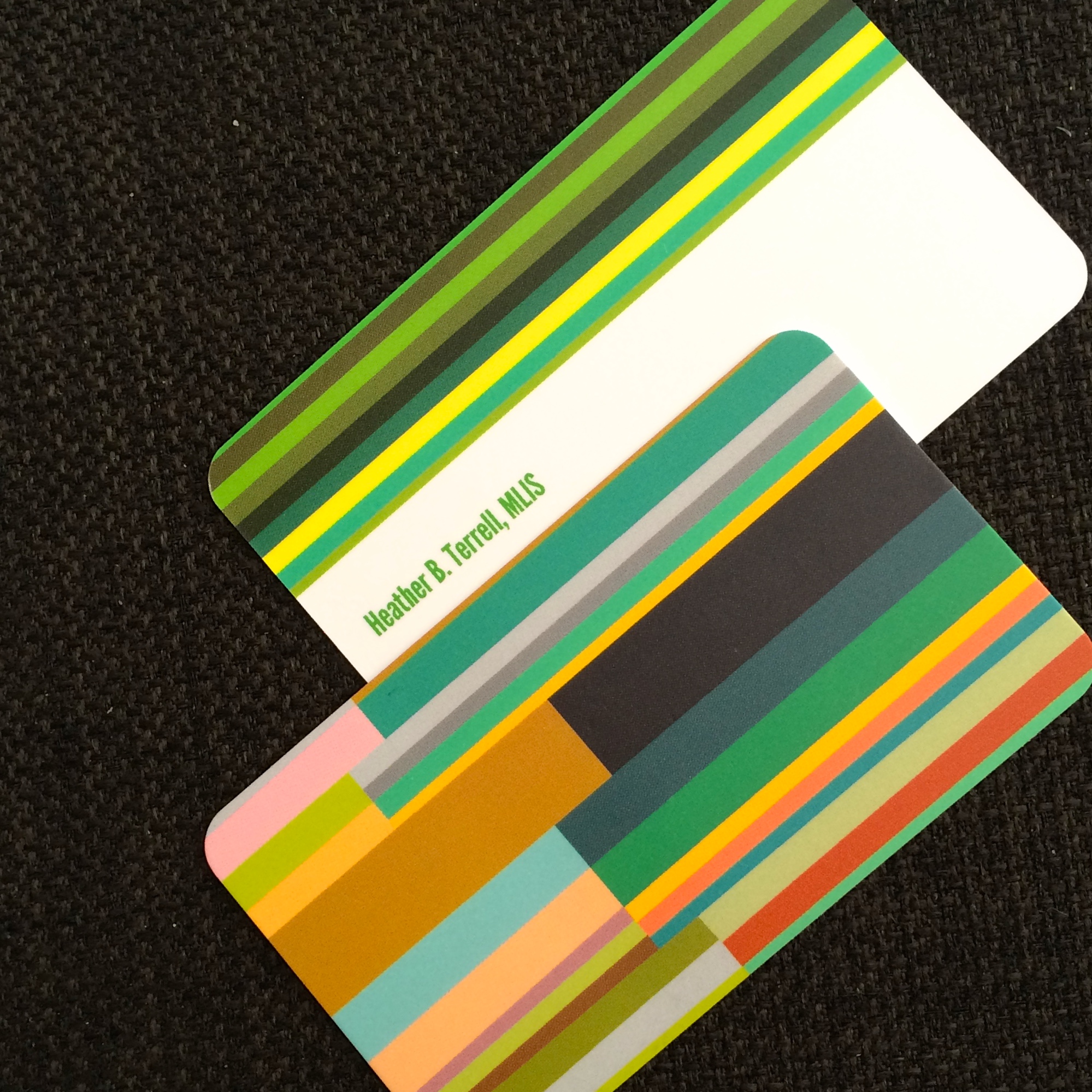
Because this isn’t a 100-yard dash, I feel comfortable taking some time to meander: to clean/purge the family office, to bike and walk and run, to read comics and play video games, and to spend hours at coffee shops reading fiction. Exploration and rediscovery is the agenda for June/July. As far as my professional life goes, I’m sending out graduation announcements this week, I’ve started handing out my new business cards, and I’m looking forward to meeting people at the ALA Conference in San Francisco next week. Ready, Set, Allons-y!

IMG_1978

2015 LITA/Ex Libris Student Writing Award

I’ve been named the winner of the 2015 LITA/Ex Libris Student Writing Award. The piece, “Reference is dead, long live reference: electronic collections in the digital age,” was adapted from a paper I wrote last semester, kind of an intersection of collection management and reference services.

It’s an argumentative essay of sorts, suggesting that there is a false dichotomy between electronic and print reference collections, that — contrary to what seems to be a worry about the impending irrelevance of library reference services — there is no cause for alarm: choosing reference sources based on user preferences and information needs is as paramount as it’s always been. I argue that the proliferation of digital reference sources is a positive development in provision of up-to-date, accurate reference information. I specifically address issues like access, reliability, and user preference.

The paper is forthcoming in Information Technology and Libraries, a peer-reviewed publication of Library & Information Technology Association. I am particularly excited about this award and publication because I plan to continue working and writing in the information/library field going forward, and this win is another step in that direction!

Conference Notes

I attended my first professional conference a few weeks ago. At the California Library Association Annual Conference in Oakland, I met some people I previously knew only virtually, I broadened my horizons in re: the possibilities of using my degree in many different capacities, and I discovered examples of people integrating their professional degrees and other skill sets to build a variegated career path. I got to be present with people who stretch the boundaries of our field and engage with information dissemination in non-traditional ways while keeping focus on the ultimate goal of library work: access.

Also, Daniel Handler. I’ve had a small lit-crush on him ever since I ran the merch table at Kidquake a couple of years ago and he was asking the kids deadpan whether they had a full-time job in a coal mine or went to third grade, then afterward told me he liked my kitchen utensils Tattly. I love the Series of Unfortunate Events (Number 13 kind of broke my heart — in a good way), and in his keynote speech at the CLA conference, the divine Mr. Handler did not disappoint: hilarious as well as inspiring.

Though I’m not quite finished with school yet — people kept introducing themselves as [name], [library] — I found the experience to be useful, in that it opened me up to possibilities I might not have considered otherwise: academic libraries, museums, and archives, oh my! I recommend that library students attend a professional conference during their educational careers — going to a variety of sessions exposes one to the universe of information science professions and professionals, and might even provide a springboard, inspiring new directions in one’s academic career.

A FIRST-TIMER’S CONFERENCE TIPS

  • Go to sessions that interest you. Whether or not a session seems imminently applicable to your current situation, if something in the description sparks your interest, try it out.
  • Have a backup plan. There will be some sessions which aren’t what you expected, are way over (or under) your head, aren’t presented very well, et cetera. It’s okay to duck out and go to another session that piques your interest.
  • Don’t overschedule. It’s fine not to go to every session. I know, I know. There’s something that looks interesting in every single time slot, but you need to eat lunch (pro tip: no one wants to sit next to you in a session as you crumple a paper bag to dig out your soggy PBJ and a handful of carrot coins). Also? You need a mental break during the day.
  • Explore the neighborhood. Leave the conference center. I know it’s difficult to tear yourself away from the free pastry in the exhibit hall, but if you get out into the fresh air for a quick coffee or a walk around the block, you’ll step back inside rejuvenated. As a rule, convention centers are much less lovely than the cities surrounding them.
  • Your keynote speaker will probably get too many questions about books during the Q & A session. If you’re a keynote speaker, be prepared to give readers’ advisory to a bunch of foaming-at-the-mouth bookworms. After all, we are librarians.

attribution: photo courtesy of http://conference.cla-net.org/2014/the-details/highlights/

A Short Guide to Group Work

Many grad students I’ve spoken with look upon group projects with trepidation. It makes sense: in the vast majority of our educational experience, we’ve been rewarded for superior individual effort, and working with a group means relying on the undiscovered skills and the work habits of others. It means relinquishing full control over the output of one’s efforts in order to complete a project that might seem easier to do alone, considering the extra work of directing others’ actions, accepting others’ interests as a guide, keeping one another on task, and being accountable, not to a professor, but to a group entity. We like being dependent on our own skills, and we know our own weaknesses. Sharing our skills and possibly being judged for our weaknesses doesn’t sound like a great way to facilitate learning.

But something happens when you really dive into a group project. You find that others’ input can be a valuable resource, that different perspectives can help you to see a problem in a new way, and that a group of disparate people can work together to accomplish something that never would have come to fruition at the same depth if those people were working alone. Kurt Lewin, a pioneer in the field of organizational psychology, was one of the first to study group dynamics in a scientific way. From Field Theory in Social Science / Selected Theoretical Papers, he concludes that, “It is not similarity or dissimilarity of individuals that constitutes a group, but interdependence of fate.” (p. 165)

Theory

This interdependence, whether in terms of a grade (MLIS) or a desired solution (IRL), allows us to engage with one another around the experience of the problem or question in the thought-work it takes to come to consensus, to consider our individual tasks as they interrelate with the tasks of others. We’re directing our energies together in a specifically focused direction. We learn from one another, we apply the theory we’ve mastered in class, and we discover the joys of self-directed education.

Occasionally, we even make friends, a nice bonus that one might think is entirely beside the point. But our friends often become valuable allies — friends who are able to provide critique and suggest new paths as we move forward in career and in life are invaluable in nudging us to try interesting things outside our usual sphere of experience.

In every vocation, there is work too big, too important for one person to complete alone, and there is work that benefits greatly from the values and ideas of several individuals working together on the parts that make the whole successful. It’s essential to cultivate this skill set in preparing for our professional lives, especially because it may not be a way of working which comes naturally to us.

Practice

For those new to working within groups, this Harvard guide is a good starting point for getting one’s bearings in a group learning situation:

http://isites.harvard.edu/fs/html/icb.topic58474/wigintro.html

In my own collaborative endeavors, I’ve found that successful work groups are made up of successful group members who accept individual accountability, interact regularly, and trade meaningful feedback to support one another in their efforts. Even if group members have nothing in common except their assignment goals, that’s more than enough to be successful.

There are several roles one might play in the context of the group to advance a project. I’ll outline a few that I’ve taken on.

The Leader directs a project and keeps all the moving parts in order, making sure all members understand the assignment goals and have a preferred way to contribute to the final product. The Leader develops a timeline and action plan which includes deadlines, is available to assist individual members as questions or issues arise during their tasks, and provides a framework for accountability as members work through the plan step-by-step.

The Mediator leads meetings, coordinates members’ schedules and develops a clear discussion plan in advance, adhering to agreed-upon start/end times. The Mediator draws out each member’s ideas and potential contributions, reconciles conflicts by eliciting consensus, makes clarifying statements to emphasize key (and/or confusing) points, steers members to keep the meeting on topic, and identifies areas where more evidence is needed or where unwarranted assumptions might be coloring the process.

The Recorder compiles the group’s ideas and distributes the results to all members. This might include keeping meeting minutes, designing graphical information displays, and answering questions regarding the events/contents of group interactions. This role requires the Recorder to ask clarifying questions during meetings, to share group resources with all members, and to synthesize group findings, presenting consensus in a clear way.

The Presenter builds the “package” for the group’s work, which might involve presenting the findings orally, designing presentation slides, and/or producing a polished culminating document which reflects all group members’ work in service to solving the assignment problem.

Each of these roles is crucial to the success of the group. Every member has an obligation to attend meetings regularly and to participate fully, e.g., suggest ideas, identify and work toward common goals, pool knowledge, offer specialized skills or lessons from experience. During meetings, listen carefully, consider the perspectives of others, and provide constructive feedback. Complete tasks by the agreed-upon deadlines. Research the topic adequately and share resources and info with other group members. Do not overwhelm group members with too many emails, texts, or IMs: use agreed-upon channels for communication, e.g., facetime meetings, google docs, weekly update emails, et cetera. This is basic group etiquette, and will go a long way in fostering an atmosphere of mutual respect, allowing members to work well together and solve the assignment problem successfully.

The best group projects allow us to collaboratively apply course concepts to complex problems. This cultivates critical thinking skills, as well as providing valuable experience in the fine art of getting things done — together. Not only do we learn how the material applies to real-world scenarios, we learn how to effectively work with others, rather than in competition with others, to achieve a goal that benefits the entire group.

Collaboration is an essential ability in any workplace — better to gain this skill set in the “safe” setting of academia than to flounder while on the job. We should relish our experience in group learning settings, embrace the process, and observe group etiquette to make every project one that challenges and strengthens us to be effective in our education and in our future careers.

attribution: image from Calvin & Hobbes comics by Bill Watterson

MLIS Lessons

Education, especially when you’re a librarian, does not stop at graduation. This is one of the things about the profession that drives me toward it. I expect that the lessons I’ve learned during grad school will carry through my career. I may end up in a very unlikely place, doing work that requires me to build experience in many different areas, collaborating with a variety of inspiring individuals who guide me in my endeavors. This is why I have taken coursework in a wide spectrum of disciplines, from history to web programming. Such a broad variety of work potentialities results in an amazing career to cultivate, full of possibility and requiring a zest for ongoing learning and adaptation!

I’ll be graduating my MLIS program this Spring. As the end (a.k.a., the beginning) draws near, I’ll share some of the things I have learned about the process of graduate work.

Where You Start May Not Be Where You End Up.

When I began, I thought I was fully committed to children’s librarianship, and that alone. After grounding in the program, I’m more interested in the ways we use technology in providing access to materials, and in information literacy for all age groups (including –just not limited to– children). My horizons have also expanded to include an interest in archives, skills in programming and web usability, and experience in research as a discipline.

Get Experience.

Doing is part of learning. I would even suggest that, if possible, prospective MLIS students plan to take fewer classes per semester so they can work or volunteer in a library, get involved with professional associations, and/or complete an internship or two along the way.

The library I’ve worked at (since before I began grad school) is a wonderful institution to be involved with, partly because we have such interesting patrons and staff, partly because of the prestige of being one of the oldest continuously operating libraries in the West, but mostly because there is an openness to trying new things in service to our members. Library management has consistently allowed me to test out what I’m learning in class in the Real World of our library. Sometimes it has failed, as in the Saturday morning storytime I tried to jump-start, which was attended by zero participants. But more often, it’s been a mutually beneficial arrangement, e.g.,

  • I completed a research class on writing grant proposals, and the proposal I wrote on behalf of my library was fully funded by a like-minded granting institution; the project is currently well underway.
  • I was inspired by course readings to suggest a staff picks display, and it has been a hit with our patrons.
  • Most recently, as a complement to my reference services course, I began leading a book group.

Developing a career begins well before graduation, and while one is collaborating with libraries and librarians, she may meet a mentor or two…

Cultivate Mentor-Mentee Relationships.

Mentors are beneficial in any profession, comparable to a guild or trade union apprenticeship. The apprentice works under the guidance of a master until she reaches journeyman status, and eventually, becomes a master herself. (Someday, MLIS student, you too may be someone’s mentor!)

Mentors can help the MLIS student identify her strengths and interests, guide her to acquire a deeper understanding of the work a librarian does, and act as an ally in all aspects of career development, from job hunting to providing references. These relationships can be casual or formal, and many mini-mentors might occupy the role of a single mentor for some. Mentorships don’t always need to be formalized, and in some cases (for me, in all cases thus far), they develop very naturally when I build relationships with people whose work interests me.

Adaptability is paramount in this vocation. If the student keeps this in mind as s/he works through the program and cultivates varied skill sets while gaining experience, the profession will begin to look like a wide-open place in which to apply what one has learned.